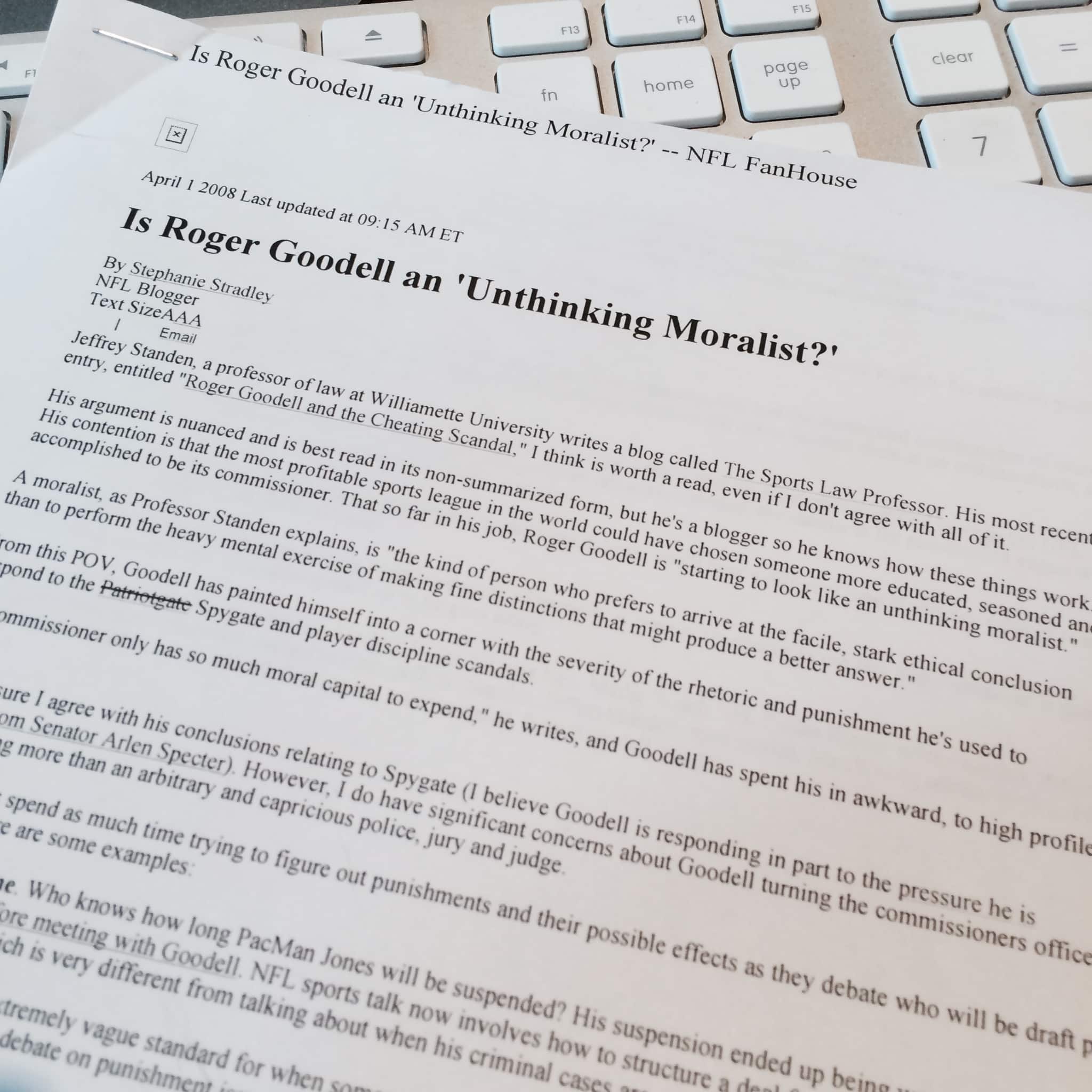
 The following is a re-typed version of a NFL discipline column I wrote about Roger Goodell for the now defunct sports blog, FanHouse. Originally, when AOL sold the name, we were told that the links would remain live. That turned out to be not true.
While it was still live, I printed off quickly a few of my favorite pieces I wrote. This is one of them. I’ve re-typed the piece in its original form without the original links that explained extra context. [the text was too small for an accurate pdf conversion]
Is Roger Goodell an ‘Unthinking Moralist’
(originally written by Stephanie Stradley, April 1, 2008 for FanHouse)
Jeffrey Standen, a professor of law at Williamette University writes a blog called The Sports Law Professor. His most recent entry, entitled “Roger Goodell and the Cheating Scandal,” I think is worth a read, even if I don’t agree with all of it.
His argument is nuanced and is best read in its non-summarized form, but he’s a blogger so he knows how these things work. His contention is that the most profitable sports league in the world could have chosen someone more educated, reasoned and accomplished to be its commissioner. That so far in his job, Roger Goodell is “starting to look like an unthinking moralist.”
A moralist, as Professor Standen explains, is “the kind of person who prefers to arrive at the facile, stark ethical conclusion than to perform the heavy mental exercise of making fine distinctions that might produce a better answer.”
From this POV, Goodell has painted himself into a corner with the severity of the rhetoric and punishment he’s used to respond to the Patriotgate Spygate and player discipline scandals.
“A commissioner only has so much moral capital to expend,” he writes, and Goodell has spent his in awkward, to high profile ways.
I’m not sure I agree with his conclusions relating to Spygate. (I believe Goodell is responding in part to the pressure he is feeling from Senator Arlen Specter). However, I do have significant concerns about Goodell turning the commissioners office into nothing more than an arbitrary and capricious police, jury and judge.
In 2008, fans spend as much time trying to figure out punishments and their possible effects as they debate who will be draft picks or how their team will do next year. Here are some examples:
Player Discipline: Who knows how long PacMan Jones will be suspended? His suspension ended up being worse because Jones decided to go to a strip club the night before meeting with Goodell. NFL sports talk now involved how to structure a deal for a player when you have no idea when his suspension will be lifted. (Which is very different from talking about when his criminal cases are resolved.)
When you have an extremely vague standard for when someone will be suspended and how long that punishment will last, it creates media and fan debate on punishment issues. These debates in the mass media will always fall along moralistic lines.
What is going to happen to Vikings left tackle Bryant McKinnie? He pled not guilty to charges of aggravated battery, disorderly conduct, and resisting arrest. It sure would be nice for the Vikings and their fans to know what the extent of his punishment will be, if any, going into the draft.
And what is going to happen to Steeler Pro Bowl linebacker James Harrison, if anything/ He was accused of breaking down his girlfriend’s door, slapping her across the face and breaking her cell phone. (The Steelers cut ties with wide receiver Cedric Wilson immediately after he was accused of something similar, but he is a worse player than Harrison, so as FanHouser J.J. Cooper explains, the Steeler standard for his behavior is higher).
Harrison’s situation doesn’t involve repeated bad acts, but it does look a little strange when former Atlanta quarterback Michael Vick is likely going to be suspended for years no matter when he gets out of jail for the abuse of his dogs. Vick sits in limbo, but it’s possiblethat there will be no suspension for a player who hits a woman. When you throw the book at some things but not with others, it can look a little incongruous, even if you have good reasons for it.
Spygate. Goodell gave the Patriots the harshest NFL sanction ever, and some believe he did it before even having all the evidence. If former Patriot employee Matt Walsh ever gets to talking and has evidence of crimes that are worse than the punishment was originally, is Goodell going to double down?
Professor Standen believes:
“The ever-widening cheating scandal that now plagues the NFL would never have happened under Paul Tagliabue’s watch. He would have quietly fined the Patriots and moved on.”
Hard to say this with certainty, but Goodell embracing the role of grandstanding sheriff creates an expectation of additional sanctions and public pronouncements. Nothing can be handled quietly anymore.
Tampering. The 49ers get draft picks taken away for doing what most all the other teams do, and they didn’t even get the tampered player. Chicago gets to benefit from the tampering charge, even though they weren’t really harmed, by switching third round picks with the 49ers.
If this is moralism, it may be a highly ineffective strain. Who knows what the long term effects of this punishment will be other than maybe changing the way that teams handle their interoffice emails/
Strangely enough, the way that Goodell’s punishment came down, he seems to conclude that violating the rule against spying on another team is 11 times worse than tampering.
Overall. Recently, Goodell put his sheriff’s hat on again, and in a memo announced that the league wants to conduct unannounced searches of locker rooms and press boxes, and to inspect in-game communications devices. After a string of alarmingly arbitrary rulings, he’s stated that he wants to lower the standard of proof needed for him to impose penalties on a coach, executive or team.
Does that really make you feel better about the integrity of the game?
Last summer I discussed my concerns that Goodell’s player personal conduct policy had the unintended consequence of increasing the attention that fans pay to bad actions. It causes fans and media to debate what potential penalties will occur because there is no real standards, and Goodell has put himself in the spotlight as the decider of everything.
Interestingly, Michael David Smith in his work for the New York Times states that the most underreported story in the NFL is the resentment that some players feel toward the commissioner. And why not? The penalties are unprecedented, the standards for punishment vague with little due process, and the publicity from this tends to bring more attention to NFL bad acts.
Thought many fans have been generally supportive of Goodell’s crackdown, you’ll hear a different tune if you ask a fan of a team trying to navigate the draft under an utterly opaque cloud of uncertainty.
Whether or not Roger Goodell is guided by an inflated sense of morality is frankly secondary to the fact that, whatever is guiding him, it isn’t consistent. For all anyone can tell, he’s just making stuff up as he goes along.
-End-
________________________________
This blog post is a bit back to the future.
Harsh, arbitrary punishments combined with no concern for fair process means that the cycle will repeat with different topics, names, processes, teams.
We will hear the headline version of events given to us by the NFL. The people investigated often cannot defend themselves publicly due to pending litigation and fears that speaking out will anger the commissioner more and be seen as lies and obstruction. Confession and remorse are often required by Goodell, and is not an option for those who maintain actual innocence.
Unfair process means that fans often don’t hear anything close to the real truth about a controversy. And we know that the process is unfair because there is no reasoned way for a targeted player, staff member, team to maintain a claim of actual innocence.
After the Brady case is done, the NFL will likely tweak their processes without looking at their overall philosophy of punishment. And the cycle will continue.

Please note: These comments below are moderated by me. I know people are angry about this subject, but I’d prefer no personal attacks of people and a focus on NFL discipline system issue questions and answers.
Legal Implications of the Judge Berman Ruling
 Blog posts can serve as time capsules, and this one focuses on the legal implications of the Judge Berman ruling. I’ve grouped together a collection of real time tweets from when the ruling was made and afterwards and have added additional commentary. Be sure to hit the read next page button at the bottom of the screen because the entire Storify does not show up on the blog posts.
I’ve been receiving a lot of questions about Deflategate legal issues as they happen, and it is easiest to collect them in one place. If you haven’t already read them, please check out my FAQ recaps on earlier events on my blog. If you scroll down a bit, you can find blog posts about other NFL disciplinary issues as well.
Because I know how hard it is to get informed information about these legal issues, I invite polite questions and comments in my comment section. I moderate them myself, so there may be a delay in them showing up and being answered.
Have any additional questions, comments? Put them below. Please read the other comments first to see if I’ve already answered them.
It’s sometimes hard to talk about legal issues to a broad audience without simplifying to the point of complete inaccuracy. So if you have any Judge Berman ruling questions or other Deflategate legal questions, please let me know. My comment community is usually a very good one. Sometimes the comments are so good, I create new blog posts just to highlight how good some of the comments are. Unusual, I know.
Issues with Bob McNair Deflategate Comments
 During the Texans Team Luncheon, Texans owner Bob McNair answered a variety of questions from Houston Sports Radio 610’s Mike Meltser and Seth Payne. Of greater interest to national fans were the Bob McNair Deflategate comments.
The comments aren’t surprising, except that he talked about the situation in more depth than most owners would. I do not think he was expecting those questions.
In general, McNair tends to be open with his comments, often more open than what his coaches sometimes would prefer. This is likely one of those times given that the Texans play the Patriots this season.
McNair’s Comments Perfectly Show the Problems with the Process.
In any event, the Bob McNair Deflategate comments are a great illustration of the naiveté most owners have with the NFL discipline process. Robert Kraft and Tom Brady thought if they were fully cooperative, they would be shown to be innocent. They were both caught off-guard with the peculiar direction that the NFL took in its investigation.
That is, the NFL ignored direct testimony denying the acts. And with no real evidence, the NFL looped together timeline and text messages assumptions and then combined them with a scientific-sounding report that would never be admissible in an actual courtroom.
What all fanbases and owners miss out on is that unless you read all the documents of various -gates and have the expertise to know what they mean, you likely do not see how manipulative and unfair the NFL discipline process is. And by the time you see it firsthand, your team has already been harmed. For a short explanation of this mindset, please read my Houston Chronicle column, “Why the Deflategate case matters.”
Where Bob McNair is coming from now is where Robert Kraft was before Deflategate. Company guy who thinks Roger Goodell is a good man, doing things in a fair way, with tough discipline decisions for the benefit of all.
Full Bob McNair Transcript.
The following is a transcript of Bob McNair’s full answers relating to Deflategate with my annotations in blue. It was part of a much larger conversation. Full answers give more context too.
If this were a courtroom, the objection to a lot of this is, “Assumes facts not in evidence.” Remember, McNair is likely relying on NFL and media reports of the facts–many of them disputed, misstated publicly, or just wrong.
Mike Meltser: “You mentioned that you talked to the Commissioner this morning, from a big picture standpoint, do you think it’s good for the business of the NFL to have Deflategate go on this long seemingly with no real end in sight?”
Bob McNair: “No, I don’t.” [Um, the NFL is in key position to settle this quickly, Mr. McNair]
“I think we [the NFL] could have handled it better, I think the Patriots could have handled it better, I think Brady could have handled it better.” [Ya think?]
“You know, when you look back on it, if Brady had just said ‘Look, my guys know I like a softer ball, and that’s what I like, and so they do it. But I don’t go out and check the pressure of the balls, I don’t know that,’ I don’t think there would been an issue. It would have been a problem with the guys on the training staff who deflated the balls, and the Patriots would have got some kind of minor penalty, it wouldn’t have been a big deal.” [What if Brady said the truth? Oh and when does Goodell ever give out minor penalties? He gave a 4 games suspension to a GM who text messaged instead of walking down the hall].
“But what escalated the whole thing is that Brady and the Patriots were going to cooperate fully, and then when it came down to it, they didn’t. And that’s what really upset the Commissioner.” [There was a legitimate dispute about the extent of cooperation. Discovery disputes are common. In normal litigation, there are sane remedies. And if “upsetting” the Commissioner is the standard for punishment, all teams and players are at risk].
Meltser: “One thing I wonder about is, Ted Wells told Tom Brady that he felt that Brady was fully cooperative and seems like a major reason he got four games is that Roger Goodell said he was not cooperative. Let’s say Tom Brady was J.J. Watt, would you feel comfortable with the level of due process that has been afforded Tom Brady through this process?”
McNair: “Well, if it was J.J. Watt, I think he would have been cooperative, and it wouldn’t be a question. I don’t think J.J. would destroy his cell phone. So, you know, that wasn’t a good sign. If people had nothing to be concerned about why would a person do that?” [1. Brady didn’t “destroy” the cell phone. b. Brady has obvious privacy concerns] So it just doesn’t pass the smell test. [No pass smell test=4 game suspension, millions of dollars of salary?].
“Is there anything conclusive there? No, you don’t have any conclusive evidence. [!!!] But the whole idea is we want to make sure we have a competitive playing field that’s level for everybody and so we don’t want people breaking the rules. And, even though, obviously, it didn’t impact the outcome of the game, I mean the Patriots just killed them. And so, that’s not really the issue. But in the minds of somebody in that organization, they thought it would give them a competitive advantage, and that’s why they did it. So you just want to eliminate that kind of situation if you can.” [“The NFL needs to enforce all rules harshly even if they didn’t matter because of no coherent reason I can articulate”].
The takeaway from McNair’s comments?
It is an interesting look into how at least one of 31 owners see this. A huge contrast from how Robert Kraft sees it.
In my time following the team, Bob McNair has struck me as a reasonable person, who wants to do the right thing, and wants to be a good team-player owner. I think this Deflategate matter puts someone with that mindset in a bad spot. I think he honestly feels the way he said based on the information that he knows and has been given. But it is hard to justify when you say it out loud.
As a Texans fan, and a fan of the NFL, it concerns me how naive the owner mindset of “Hey if we just cooperate with Roger Goodell, we will get a fair hearing and minor discipline at worst.” That all comes from the wrong assumption that if you don’t cheat, you are safe. But that isn’t the case if the arbitrary and bad notice process problems make claims of actual innocence impossible to maintain.
Process matters. But process problems in both the criminal justice system and in the NFL discipline system are harder to articulate than inaccurate destroyed phone kind of headlines. The affected teams sees it. Their fans see it. And their concerns are blown off as just being biased.
And in the meantime, the rest of the owners are just trying to be good team players. Who would be better off not trying to explain the inexplicable.
___________
Have any additional questions, comments on this or any other Deflategate legal matter? Put them below. Please read the other comments first to see if I’ve already answered them.
Please note: I moderate this blog myself, and I do not want any abusive comments about anyone or any commenter. Plenty of places on the web for abuse, but I don’t want a blog with my name on it to be a place for that. I moderate and answer questions when I have a little time. Thanks for making this place cool.
Did Roger Goodell lie about Tom Brady, Deflategate?
From both media and fans, I’ve been receiving the question: “Did Roger Goodell lie about Tom Brady and Deflategate events?”
When I get a question repeatedly, it is easier to write a more complete answer in a blog post.
Personal note to put this in context. I feel very uncomfortable with the term “lie” and judging people in general. For me, fair commentary about anything–football, business, law, etc–is the sort of commentary that I would feel fine saying to them personally.
More fair, less cowardly.
Let’s walk through the above question and various related questions:
Did Roger Goodell lie about Tom Brady in his arbitration ruling?
After the NFL – Tom Brady Deflategate transcript was not sealed by the judge, it made it easy to compare what was actually said under oath, and how the NFL represented to the world what was said.
Clearly, Roger Goodell did not write the actual arbitration ruling himself. He would likely not do that even if he were a lawyer-commissioner because that wouldn’t be a good use of his time.
Arbitration rulings of this sort are crafted by lawyers with the intention of helping defend future litigation. They typically try to show that they considered all the evidence fairly, rejected some of it for whatever reasons, and then rule a particular way.
Roger Goodell signed it. So, that would suggest that he at least read it and endorsed its contents.
There are any number of commentators who believe that the NFL and Roger Goodell were ___words used to suggest less than truthful___.
Dan Wetzel from Yahoo Sports:
Roger Goodell’s manipulation of Tom Brady’s testimony leaves NFL on slippery slope
Wetzel: Goodell’s Egregious Mischaracterization Of Brady’s Testimony Worse Than Any Deflated Footballs
Dan Steinberg – D.C. Sports Bog/The Washington Post:
Roger Goodell misled me on Tom Brady. I won’t trust him again.
Doug Nyed – NESN:
Roger Goodell Made Tom Brady Seem Dishonest In Deflategate Appeal Ruling
(I leave these things here as a time capsule of sorts. I’m sure there’s more stuff but, you get my point here).
The genteel, lawyerly way “lie” is usually said is, “misstates facts.” Or as Ted Wells might say in the Wells Report, in my judgment “lacking candor,” or “not credible.”
These lawyerly words are often used to avoid saying “lie” because it is hard to judge what is in someone’s heart. And various defamation things. (We will revisit defamation sorts of things later).
One reason why the judge wants to get the NFL and NFLPA to talk settlement in person is to get the lawyers more out of it. Lawyers act as weapons and buffers and shields and often serve as the blame point when settlement is going on. Sometimes they are actually to blame. Then the parties can play the ego-filled, face-saving “Hey, this is not me, this was the lawyers” game without saying it that plainly.
Getting the lawyers out of the room makes the parties get more real.
One thing for an arbitration ruling to say more probable-than-not-legalblurghy-stuff-not-credible. It’s another to get together in a room. And for one man to tell another man in essence they are liars to their face.
Not hiding behind legal standards, and burdens, and inferences, and bought scientific-sounding endeavors.
Frankly, the fancy pants way of best describing the truthiness level of this entire NFL enteprise is this:
Disingenous: /disənˈjenyo͞oəs/adjective – not candid or sincere, typically by pretending that one knows less about something than one really does.
Beyond how the arbitration hearing characterized the evidence, here’s the boilerplate fiction that is a crock:

Plain as day.
Deflategate Legal Time Capsule: Judge Berman Speaks
 This is a time capsule of Deflategate legal thoughts. The focus is on the August 14 NFL/NFLPA Memorandums in Opposition, the August 12th settlement hearing and related issues.
I’ve been receiving a lot of questions about Deflategate legal issues as they happen, and it is easiest to collect them in one place. If you haven’t already read them, please check out my FAQ recaps on earlier events on my blog. If you scroll down a bit, you can find blog posts about other NFL disciplinary issues as well.
Warning; These posts may cause feelings of severe deja vu.
(Please note: In order for the comments to be worth reading and answering, I moderate this blog personally. When I have time to do it. My rules are no spam, vulgarity or name-calling attacks on any people or commenters. Most people are really good about that, and just about everything gets published. Sometimes comments shape my thinking, including being challenged and informed by alternative views.
I’m highlighting my guidelines as um, fair notice, as some of the topics in this blog post may make some want to attack media members. Like or dislike whoever you want because this is America, but I honestly don’t want to see that here. It tends to shut down reasoned disagreement and devolves the quality of the comments when people are focused on attacking human beings instead of arguments.
In addition, please check previous posts first to see if I’ve already answered your question. The focus on these posts are legal questions and the facts as they apply to the law. Thanks again for being cool.)
Have any additional questions, comments? Put them below. Please read the other comments first to see if I’ve already answered them. I do not have a staff because I’d rather keep overhead low and my own money.
It’s sometimes hard to talk about legal issues to a broad audience without simplifying to the point of complete inaccuracy. So if you have any Deflategate settlement, memorandum of law legal questions of a more or less detailed nature than above, please let me know. My comment community is usually a very good one. Sometimes the comments are so good, I create new blog posts just to highlight how good some of the comments are. Unusual, I know.
Legal Snapshot: NFL v Brady Deflategate Filings
 On August 7, 2015, the NFL and NFLPA offered their Deflategate filings– motions and memorandum of law to federal court Judge Richard Berman of the Southern District of New York.
Previously, I collected a legal snapshot of views after the Deflategate transcript that was released.
By request, I’ve collected various legal snapshot of views for the Deflategate filings below, specifically the NFL and NFLPA Memorandum of Law. Also added some additional comments.
It makes it easier to read and further discuss the contents by putting these things in one place. It also serves as a time capsule.
__________________
Have any additional questions, comments? Put them below. Please read the other comments first to see if I’ve already answered them. I do not have a staff because I’d rather keep overhead low and my own money.
It’s sometimes hard to talk about legal issues to a broad audience without simplifying to the point of complete inaccuracy. So if you have any Deflategate filings, memorandum of law legal questions of a more or less detailed nature than above, please let me know. My comment community is usually a very good one. Sometimes the comments are so good, I create new blog posts just to highlight how good some of the comments are. Unusual, I know.
(Please note. This is my blog, it has my name on it, so I have rules. For those who don’t know, I approve each comment individually and will approve most stuff unless it is abusive or spam. Unlike some places on the web, I strongly prefer for people to attack arguments and NOT people. What that means is that I do not want any personal attacks against people you dislike or other commenters. Avoiding personal attacks make the comments helpful to others’ understanding and doesn’t derail conversation into middle school neener neener stuff. This is a forum to create reasoned commentary and questions on the legal issues and not for trash talk because there are many other places on the web for that, and I do not want to facilitate it. In addition, since the issues right now are mostly ones of process and law, I am not interested in this being a forum for discussing the detailed facts unless they have some relevance to the process issues which are the main ones relevant in the on-going court case. Think of this as fair notice. Thank you kindly for your cooperation.)
